A spinal cord injury can damage the nerves that control movement, sensation, breathing, and bladder or bowel function, even when the spine’s bones appear intact. You will learn which warning signs demand emergency care, what to do before help arrives, how clinicians assess the injury, and why treatment timing affects recovery without guaranteeing it.
Key takeaways
- Treat new weakness, numbness, or loss of bladder control as an emergency.
- Keep the neck and spine still until clinicians complete an assessment.
- A normal initial X-ray does not rule out spinal cord damage.
- Surgery is considered when compression or instability threatens the cord.
What Counts as a Spinal Cord Injury and When Is It an Emergency?
The spinal cord injury definition is damage to the cord or its blood supply that disrupts nerve function. It differs from a spinal fracture: a broken vertebra can leave the cord intact, while bruising, swelling, bleeding, disc disruption or compression can injure the cord even when an initial X-ray looks normal.
MRI may be needed when symptoms do not match the X-ray or CT findings.
After a road crash, fall, sports injury or penetrating injury, treat these emergency signs as urgent:
- New weakness or paralysis
- Loss of sensation or trouble walking
- Loss of bladder or bowel control
- Numbness around the groin
- Breathing difficulty
- Severe neck or back pain after trauma
First aid after spinal injury starts with calling emergency services. Keep the person still, avoid unnecessary neck movement, and do not straighten the spine. Do not move the person unless immediate danger, such as fire or traffic, makes movement unavoidable.
Symptoms can appear immediately or develop over minutes to hours as swelling or bleeding increases. Feeling well at first does not rule out a serious injury or end the need for evaluation. Early medical care helps limit secondary cord damage from swelling, bleeding, instability and reduced blood flow.
Why the First Hours Focus on Stabilisation, Not Immediate Surgery
The first hours prioritize acute spinal cord injury stabilisation, not immediate spine surgery, because preventable failures can worsen neurological damage before an operation is safe.
- Secure the airway and support breathing, especially after a cervical injury.
- Check circulation, stop external bleeding and search for internal hemorrhage.
- Maintain spinal motion restriction during examination and transport, avoiding unnecessary movement or attempts to straighten the spine.
- Correct low oxygen levels and low blood pressure promptly.
- Reassess neurological and respiratory function while imaging and surgical decisions proceed.
Hypoxia and hypotension are dangerous because injured cord tissue has little reserve for reduced oxygen and blood flow. A fall in either can turn potentially recoverable injury into secondary spinal cord damage.
Do not label every post-trauma low blood pressure episode as neurogenic shock. Neurogenic shock follows loss of sympathetic tone and causes hypotension with relative bradycardia and warm skin; hemorrhagic shock results from bleeding. Bleeding remains common after trauma, and both conditions can coexist.
A collar and other restrictions limit harmful movement during evaluation, not justify prolonged rigid immobilisation. Clinicians reassess them because extended collar use can cause pressure ulcers, impaired swallowing, increased intracranial pressure and respiratory complications.
Cervical and high thoracic injuries need early respiratory surveillance. Teams may measure serial vital capacity, assess cough strength and blood gases, and involve respiratory specialists if weakness, retained secretions or declining breathing appears.
How Clinicians Find the Injury Level and Confirm Cord Damage
After significant trauma, emergency clinicians perform a spinal cord injury neurological examination immediately, then repeat it when symptoms evolve. Seek urgent review for new weakness, sensory change, walking difficulty, or bladder and bowel symptoms, even if the first scan or examination was reassuring.
The examination measures muscle strength, sensation, reflexes, breathing function, bladder and bowel control, and sacral sparing. Using the International Standards for Neurological Classification of Spinal Cord Injury and the ASIA impairment scale, the clinician records the neurological level and completeness.
Cervical injuries affect the neck region, thoracic injuries the chest or upper back, lumbar injuries the lower back, and sacral injuries the pelvis. A complete and incomplete spinal cord injury differ by sacral function: complete injury preserves no sensory or motor function in the lowest sacral segments; any sacral sparing means the injury is incomplete.
Central cord syndrome, with greater arm than leg weakness, and anterior cord syndrome, with prominent motor and pain-temperature loss, are distinct incomplete patterns, not scan labels alone.
CT versus MRI spinal cord injury testing answers different questions:
| Test | What it shows | When it matters |
|---|---|---|
| CT | Fractures and spinal alignment | Initial trauma assessment |
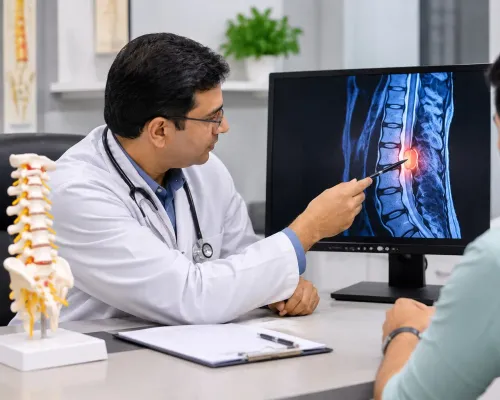
| MRI | Cord edema or hemorrhage, disc or ligament injury, epidural hematoma, and compression | Neurological findings do not match CT, or cord damage needs definition |
| CT angiography or other vascular imaging | Arterial injury | Suspected vertebral or spinal artery damage |
A normal CT does not exclude important cord damage. Repeated standardized examinations often reveal more than one early impression.
When Decompression, Stabilisation and Medical Treatment Are Considered
For an adult with acute traumatic spinal cord injury and radiologically confirmed compression, spinal cord decompression within 24 hours is generally recommended when medically feasible. The aim is to remove ongoing pressure and prevent further damage, not to reverse tissue already destroyed.
| Treatment | Purpose | Timing and limits |
|---|---|---|
| Decompression | Relieves pressure on the spinal cord | Within 24 hours when feasible; timing can change with instability, polytrauma, brain injury or unsafe operative risk |
| Spinal stabilisation | Holds the spine in safe alignment for mobilisation and rehabilitation | Performed with decompression or separately, according to the fracture, alignment and medical condition |
| Blood-pressure support | Preserves spinal cord perfusion | Augment mean arterial pressure to 75–80 mmHg, avoiding active elevation beyond 90–95 mmHg, for about 3–7 days |
| Methylprednisolone | A possible treatment for selected adults | A 24-hour infusion begun within 8 hours is an option; do not start after 8 hours or use a 48-hour infusion routinely |
A technically successful operation does not guarantee immediate movement or sensation. Early surgery is associated with better neurological recovery on average, but it cannot reliably restore cells that have already suffered irreversible injury.
Mean arterial pressure spinal cord injury management requires careful monitoring. The 2024 guideline recommendation is weak because evidence is limited, while vasopressors used to raise pressure can cause arrhythmias, cardiac strain and other complications.
Methylprednisolone acute spinal cord injury treatment is not routine. Infection, gastrointestinal bleeding and other steroid complications must be weighed before offering the selected 24-hour option. Decisions belong to the trauma, spine and critical-care team after stabilisation.
What Early Recovery Depends On After the Emergency Phase
Recovery depends on active management and repeated assessment, not on an operation or the first hospital scan. Bladder and bowel loss requires spinal cord injury bladder and bowel management, not waiting for function to return.
- Drain the bladder when necessary to prevent retention and kidney damage.
- Create an intermittent-catheterisation plan with timing, technique and review.
- Schedule bowel care to limit constipation and ileus.
- Protect the skin and check for urinary infection and autonomic complications.
DVT prevention after spinal cord injury starts early because paralysis, trauma and immobility increase the risk of deep-vein thrombosis and pulmonary embolism. Use mechanical measures and anticoagulant prophylaxis when bleeding and operative considerations permit; clinicians select the drug and start time individually.
Pressure injury prevention requires repositioning, pressure-redistributing surfaces, daily skin inspection, moisture control, adequate nutrition and a suitable bed or wheelchair system. Reduced sensation can hide a serious ulcer until tissue damage is advanced.
A single early examination cannot establish spinal cord injury prognosis and rehabilitation needs. Repeated standardised examinations track neurological level, completeness, motor findings and sensory findings; age, associated injuries and complications also shape recovery, not the scan alone.
After stabilisation and imaging, a neurosurgical team such as Dr Amit Aiwale-Best Neurosurgeon in Thane can interpret cord compression, assess operative feasibility, coordinate rehabilitation priorities and explain what the examination means next. This supports timely assessment, not an assumption that surgery is always the answer.
Related services
Spine Fracture Treatment Dr Amit Aiwale is the Best Spine Fracture Treatment Specialist in Kasarvadavali, Thane West and Tahne. View service → |
Spinal Fixation Spinal fixation is a surgical procedure that stabilizes the spine by using medical hardware, such as rods, screws, and plates, to fuse two or more... View service → |
Frequently asked questions
What counts as a spinal cord injury and when is it an emergency?
A spinal cord injury damages the cord or its blood supply and disrupts nerve function. New weakness, numbness, loss of coordination, or bladder and bowel control after trauma requires emergency care.
Why does early treatment focus on stabilisation rather than immediate surgery?
Clinicians first protect breathing, blood pressure, spinal alignment, and the cord from further injury. They complete examination and imaging before choosing an operation.
How do clinicians identify the injury level and confirm cord damage?
They map strength, sensation, reflexes, and bladder function during a neurological examination. CT shows fractures and alignment, while MRI can reveal cord swelling, bleeding, disc disruption, or compression.
When are decompression, stabilisation, and medical treatment considered?
Decompression is considered when bone, disc, blood, or swelling compresses the cord. Stabilisation is considered when the spine is unstable; medical treatment also addresses breathing, blood pressure, pain, and complications.
What affects recovery after the emergency phase?
Recovery depends on the injury level and completeness, early neurological findings, complications, rehabilitation, and the patient’s ability to participate in ongoing therapy.