A stiff neck does not automatically mean a pinched nerve, and arm discomfort does not always start in the neck. By tracing how worn discs, facet joints, bone growth and narrowed nerve openings affect movement and nerve signals, you can compare your symptoms with common patterns and recognise when assessment is urgent.
Key takeaways
- Neck stiffness can result from joint, disc, and muscle changes without nerve compression.
- A narrowed cervical nerve opening can cause arm pain, tingling, numbness, or weakness.
- Symptoms worsened by neck movement often point to the cervical spine.
- Seek medical assessment for arm weakness, balance problems, or worsening numbness.
Why Cervical Spondylosis Makes the Neck Feel Stiff
Cervical spondylosis can make your neck stiff without compressing a nerve because age-related changes reduce the smooth movement of the cervical joints. The restriction comes from local joint, disc, and muscle changes, not necessarily from nerve pressure.
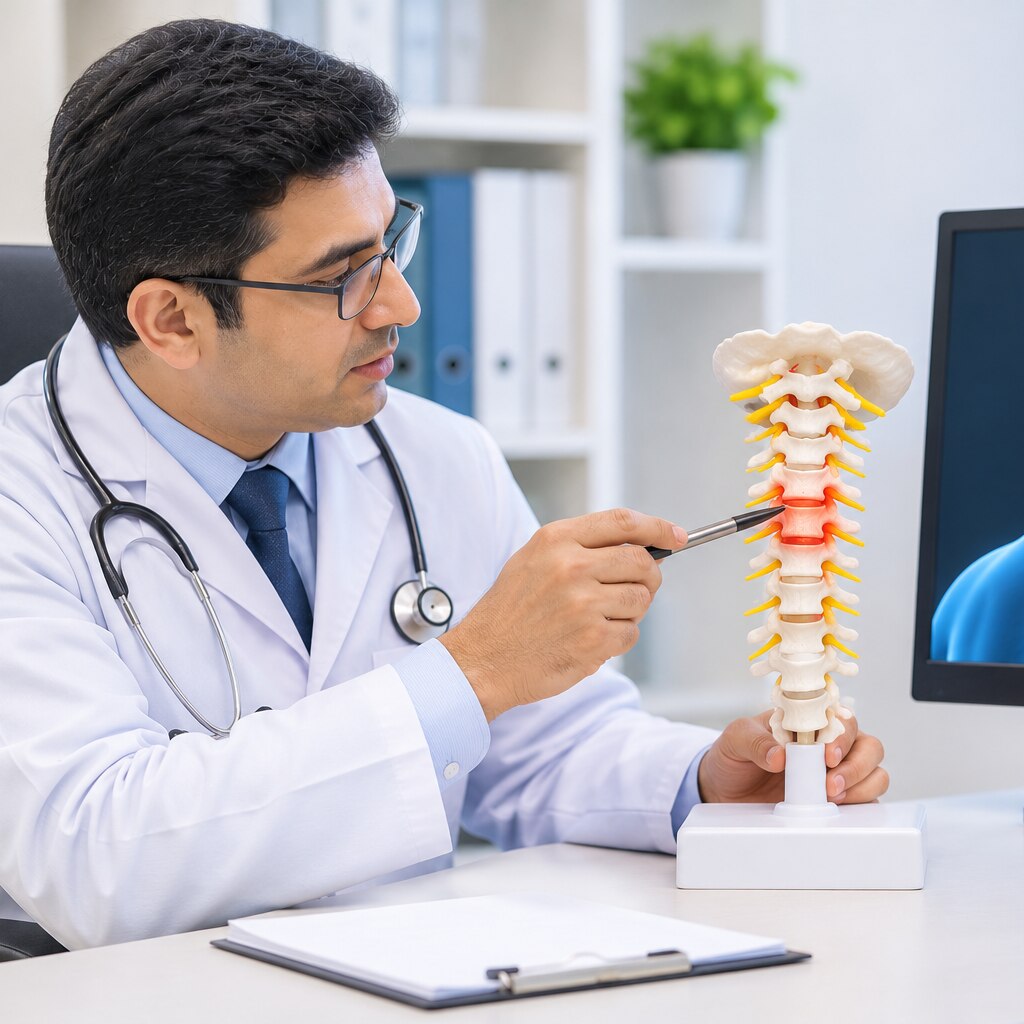
- Disc dehydration reduces the disc’s water content and flexibility, so it absorbs movement less effectively.
- Disc-space collapse lowers the height between neighbouring vertebrae, limiting the normal glide and bend of the neck.
- Facet-joint wear irritates the small joints behind the discs, making rotation and extension painful or restricted.
- Osteophyte formation adds bony growth around stressed joints, further reducing available movement.
Painful movement triggers muscle guarding: muscles around the neck tighten to protect an irritated segment. That tightening can make the neck feel heavy, locked, or difficult to turn, even when an MRI shows no compressed nerve root. Holding the head still for long periods can reinforce the stiffness.
Neck stiffness alone does not prove cervical nerve compression. Nerve involvement becomes more concerning when discomfort travels from the neck into the shoulder, arm, forearm, or hand, or when numbness, tingling, or weakness appears.
Severe or progressive hand clumsiness, balance trouble, leg stiffness, or bowel and bladder changes require prompt medical assessment because they can indicate spinal-cord involvement rather than simple local stiffness.
How a Narrowed Nerve Opening Creates Arm Discomfort
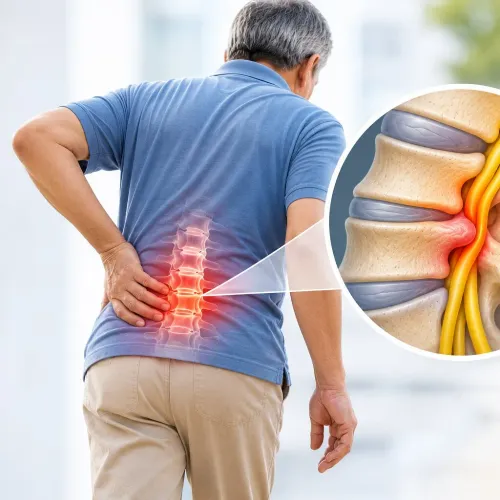
A narrowed neural foramen can turn a neck change into arm symptoms. This opening is the passage between two cervical vertebrae where a nerve root leaves the spinal canal. Disc dehydration, a bulging disc, or a disc-osteophyte complex can reduce its space; movement then adds pressure and inflammation around the nerve.
That nerve-root irritation sends symptoms along the nerve’s route rather than keeping them in the neck. You may feel sharp or burning pain, tingling, numbness, heaviness, or weakness in the shoulder, arm, forearm, or hand. The exact pattern depends on which root is affected.
- C5 nerve root symptoms can include pain around the shoulder and weakness when lifting the arm.
- C6 irritation can cause symptoms down the thumb side of the forearm and into the thumb or index finger.
- C7 irritation can affect the back of the arm, triceps strength, and the middle finger.
These maps overlap, so a symptom location does not prove the affected level. A clinician compares sensation, reflexes, and strength in specific muscle groups; a neck-positioning test that reproduces arm pain supports the possibility of radiculopathy but cannot confirm it alone.
Pain that stays in the neck points less clearly to nerve compression than discomfort that travels into the arm or hand. Shoulder disorders and trapped nerves farther down the limb can mimic this pattern.
Progressive weakness, clumsy hands, balance trouble, or symptoms in both arms and legs need prompt assessment because they can signal spinal-cord involvement.
What Symptom Patterns Point to the Neck—and What Patterns Do Not
Stiffness that stays in the neck and changes with turning, looking up, or prolonged posture points more toward local joints or muscle guarding than nerve compression. Radiculopathy is more likely when neck pain travels into the arm and follows a consistent area of altered sensation or weakness.
- C6 symptoms often include pain or tingling down the outer forearm with thumb-side numbness, plus weakness when lifting the wrist or elbow.
- C7 symptoms often include pain toward the back of the arm, middle-finger symptoms, or reduced strength when straightening the elbow.
- Shoulder disease causes pain with reaching overhead or behind your back, and weakness may remain centred around the shoulder rather than running into the hand.
- Muscle strain causes tender, tight areas and pain with local contraction; it does not usually produce persistent numbness, reflex changes, or specific finger symptoms.
- Wrist nerve entrapment produces hand symptoms without neck pain that reproduces them; tapping or bending the wrist may worsen them.
- Chest-related pain needs urgent attention when it appears with exertion, breathlessness, sweating, nausea, or pressure rather than neck movement.
A clinician compares sensation, reflexes, and strength because symptom maps overlap. A neck-positioning test that reproduces arm pain supports a cervical source, but fever, widespread aching, unexplained weight loss, or symptoms on both sides suggest a systemic problem instead. MRI findings alone do not identify the cause.
Which Changes Mean You Need Medical Assessment
Arrange medical assessment promptly if arm symptoms are worsening, weakness is progressing, or neck stiffness is accompanied by changes in hand or leg function. These findings can signal spinal-cord compression rather than isolated irritation of one cervical nerve root.
| Change you notice | Why it matters | Action |
|---|---|---|
| Progressive weakness, dropping objects, or loss of hand dexterity | Reduced grip and fine control can indicate cervical myelopathy | Arrange prompt clinical assessment |
| Gait imbalance, leg stiffness, or weakness | Spinal-cord involvement can affect walking and both legs | Seek prompt assessment; do not continue home observation |
| Numbness or weakness in both arms, both legs, or a broad area | A single compressed nerve root usually follows a narrower pattern | Arrange urgent medical review |
| New loss of bladder or bowel control, rapidly worsening weakness, or inability to walk safely | These are serious neurological warning signs | Seek emergency care immediately |
Pain, tingling, numbness, or weakness travelling from the neck into the shoulder, arm, forearm, or fingers also deserves review when it persists, returns frequently, or interferes with sleep, work, grip, or daily tasks. A clinician can test sensation, reflexes, and specific muscle groups rather than judging severity from pain alone.
Neck stiffness that is steadily improving and causes no arm, hand, balance, or bladder symptoms is less concerning for urgent nerve or cord compression. Stop home observation if the pattern changes or function declines.
How Clinicians Confirm the Source and Choose the Next Step
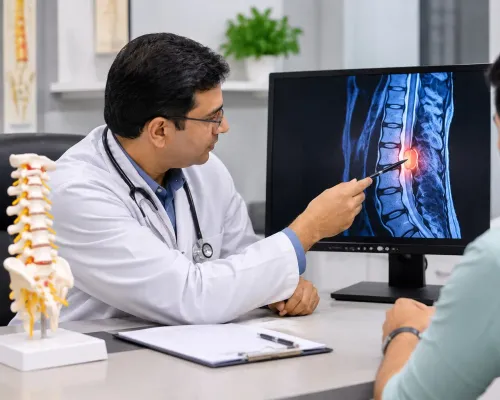
Confirmation starts with examination, not a scan. A neurologic examination checks sensation, strength in named muscle groups, coordination, gait, and reflexes; reflex asymmetry or measurable weakness supports nerve-root involvement more than neck stiffness alone. The Spurling test may reproduce arm pain by narrowing an opening, but it cannot confirm the diagnosis by itself.
| Finding | What supports it | How clinicians confirm or act |
|---|---|---|
| Cervical spondylosis | Stiff neck, reduced movement, disc or facet wear, osteophytes | Examination plus plain radiographs when alignment and bony degeneration need review |
| Nerve-root compression | Pain, tingling, numbness or weakness following a partly overlapping root pattern | Cervical MRI shows discs, foramina, nerve roots and soft-tissue compression; compare it with examination findings |
| Spinal-cord involvement | Hand clumsiness, poor fine motor control, imbalance, leg stiffness or weakness, bowel or bladder changes | Prompt assessment and cervical MRI; these findings require more urgency than isolated arm pain |
An MRI abnormality alone does not prove it causes symptoms: age-related changes are common, so the scan must match the affected side, level and examination. Seek specialist care for progressive weakness, persistent disabling radicular pain after appropriate nonoperative care, or any sign of myelopathy.
Surgery enters the discussion when those problems persist or progress, not because a scan merely shows spondylosis. Dr Amit Aiwale-Best Neurosurgeon in Thane can help distinguish nerve-root irritation from cord compression when examination and imaging need specialist interpretation.
Related services
Spondylosis Treatment focuses on relieving pain and maintaining activity, starting with conservative methods like rest, over-the-counter pain relievers (ibuprofen,... View service → |
Spondylolisthesis Treatment Spondylolisthesis, often referred to as spinal listhesis, is a condition where one of the vertebrae in the spine slips forward or backward over the... View service → |
Frequently asked questions
Why does cervical spondylosis cause neck stiffness?
Age-related changes in the cervical joints, discs, and surrounding muscles can restrict smooth neck movement without compressing a nerve.
How can a narrowed nerve opening cause arm discomfort?
A narrowed opening between cervical vertebrae can irritate or compress a nerve root, causing pain, tingling, numbness, or weakness along the arm.
Which symptom patterns suggest the neck is causing arm discomfort?
Arm symptoms linked to neck movement, radiating along a consistent path, or paired with neck stiffness point toward a cervical source.
When should neck stiffness and arm discomfort receive medical assessment?
Arrange assessment for persistent or worsening symptoms, arm weakness, increasing numbness, balance problems, or difficulty using your hands.
How do clinicians confirm whether the neck is causing these symptoms?
Clinicians combine your symptom history with a neurological and neck examination, then use imaging or other tests when the findings require them.
Related service
Spine Radiculopathy Spine Radiculopathy, or a pinched nerve, occurs when a nerve root in the spinal column is compressed or irritated, causing symptoms like pain,... View service → |